Last month, I had the incredible opportunity to spend seven unforgettable nights in Cuba with Surrey Cigars. It was truly a dream trip and worth every penny. For £2,000, we experienced an action-packed itinerary, diving deep into Cuba’s rich cigar heritage as a group of ten passionate enthusiasts. It’s not something I could have ever planned alone, and I’m so glad I shared it with this amazing group of people.

In this post (Part 5 of my cigar adventure), I’ll share the details of our visits to the cigar factories!
If you missed the earlier posts, catch up here:
Part 1 – Before the trip
Part 2 – Getting there and first impressions
Part 3 – Visiting the Alejandro Robaina Tobacco Plantation
Part 4 – Visiting the Hector Luis Prieto Tobacco Plantation
Forthcoming posts will cover the cigar shops we visited!
Cruising Havana in style
You only need one day to visit the cigar factories, those that allow the public access. Luckily our day kicked off at our hotel, the Iberostar Selection Parque Central. Waiting for us outside? Three brightly coloured classic American cars, straight out of a 1950s postcard. Honestly, there’s no better way to tour Havana than in one of these beauties. This served as our transportation to the cigar factories!

Travelling around the city in these classic cars was a lot of fun and certainly beat hopping onboard the more regular looking taxi’s! The cost for the cars and tour (bespoke to our taste) was around $45 per person, for approx 5-7 hours and I reckon you could probably negotiate a good deal with the drivers if you’re not in a tour group—there were plenty outside our hotel.

With cigars in hand, George, Alistair, and I were ready to cruise Havana in style. Our drivers were fantastic, taking us past landmarks like the stunning Capitol building. The weather? Perfecto.

It felt like we were in a 1950s movie, with classic cars passing us by on every corner. To the locals, we probably looked like proper Brits abroad, but in my head, I was the star of an Oscar-winning scene, proudly wearing our Surrey Cigars t-shirt’s—a thoughtful gift from James of Surrey Cigars to commemorate our trip 🙏.
Real Fábrica de Tabacos Partagás
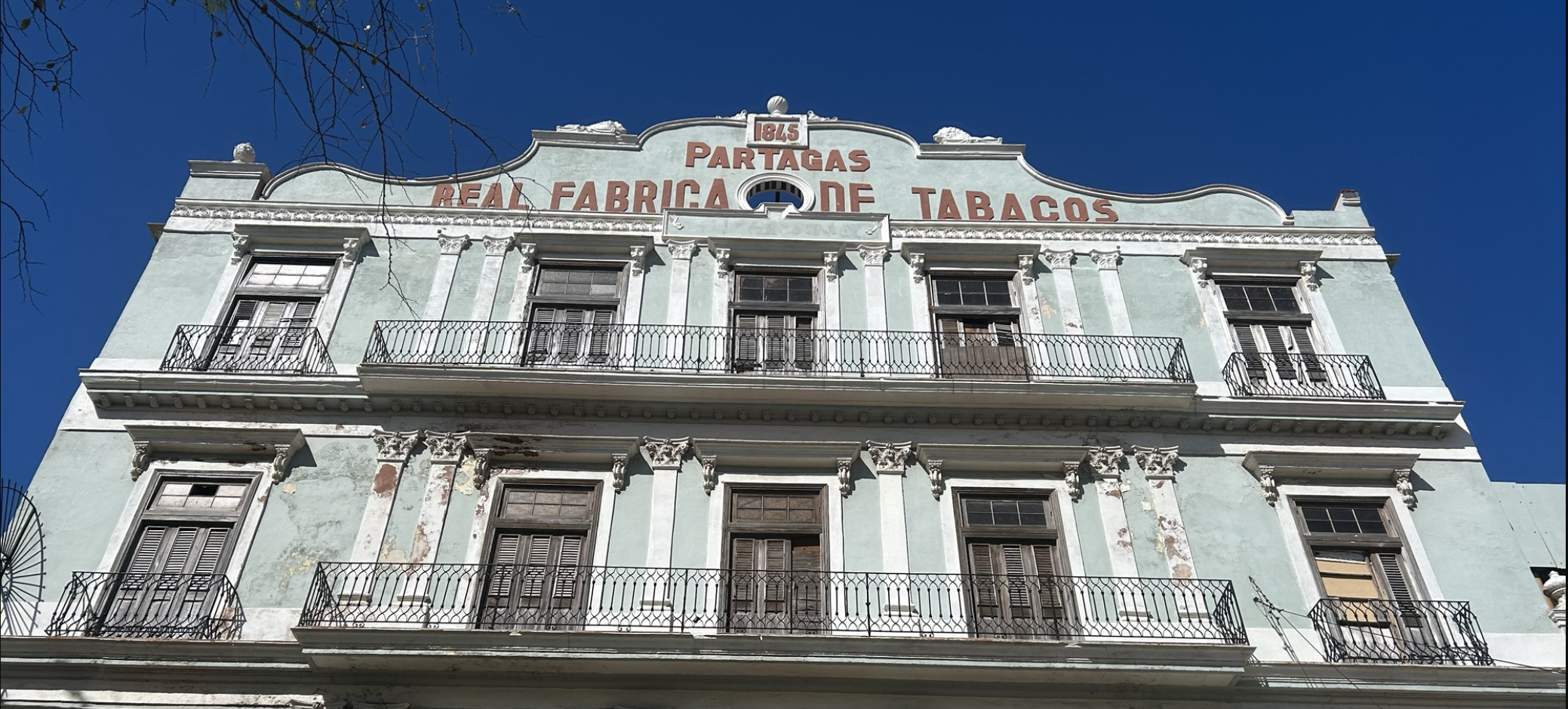
Our first stop was the iconic Real Fábrica de Tabacos Partagás, founded in 1845. Sadly, the factory seemed closed and possibly out of operation. There was talk of a shop inside, but it was shuttered when we arrived.

Still, I couldn’t resist snapping a photo. The building oozes history—definitely worthy of protected status. I truly hope it’s preserved. If this were in the UK, it’d be Grade-listed without question.
H.Upmann & Romeo y Julieta Factory
Next, we headed to the H. Upmann & Romeo y Julieta Factory on Calle Padre Varela. The building’s vibrant blue façade made it easy to spot. This facility, historically linked to Romeo y Julieta, has evolved and now houses workers from the nearby H. Upmann factory while renovations take place.

I was a little confused by this sign though (see below), that suggests H.Upmann have been here since 1844?

After a short wait, we were let into the factory. Inside, it felt like stepping into a classic building with charm and character.

There were many levels above us from the ground looking upwards.

Our tour began with a warm welcome from our guide, who spoke in English and wore a headset with a speaker so we could hear her clearly. She introduced us to the factory, and we were off on our tour.

As we explored, the branding inside the building felt a bit muddled, with H. Upmann imagery appearing alongside references to Montecristo?!

A key takeaway from my visit was discovering that these Cuban cigar factories often produce multiple brands under one roof—a practice that I’m assuming began after the industry was nationalised in the late 1950s under Fidel Castro.
At the H. Upmann factory, we saw cigars being made not only for H. Upmann but also for Montecristo, Cohiba, and others. In fact, the factory produced last years special edition Trinidad cigars in 2024 to mark the brand’s 55th anniversary. I had always assumed each factory focused on a single brand, so this was an eye-opening insight!
Unfortunately, photos weren’t allowed on the tour, which was a shame, but we did manage to snap a picture with the master blender—the most important person in the factory. He’s the one who knows every ingredient and recipe for every cigar blend produced here. He’s the boss. I didn’t catch his name, but if anyone knows who it might be, feel free to let me know.

The factory is spread out over several floors, with rollers on one level and quality control and packaging on others.

I’d always heard that rollers used to have someone read newspapers or even books to them while they worked, and while that tradition still exists (see video below)…
It seems that digital streaming services on smartphone technology have taken over these days. It was surreal to see workers watching what appears to be Netflix and messaging on apps like WhatsApp between rolling – I guess helping pass the time.
On a typical day, the rolling gallery is bustling with workers crafting around two million cigars a year.
Sadly, we didn’t get to see the banding or boxing process, which would have been fascinating to witness, but I understand—I get it—it’s a working factory, not a museum.
Before we left, we stopped at the LCDH (La Casa del Habano) shop.

I didn’t go overboard since I had already picked up some custom rolls to bring back to the UK, but I couldn’t resist getting a H. Upmann Sir Winston cigar, which felt like a rare find. I grabbed it as a single stick because I may not be able to afford them again in the future back home in the UK.
NEW Partagas Factory
Next stop: the NEW Partagás Factory. This was very close to the H.Upmann and Romeo y Julieta factory – literally across the street!

This one, located farther from the original.

It has a completely different look to H.Upmann—soft yellows and reds, almost like a colosseum.


In the main hallway, a large portrait of Fidel Castro greeted us. It was a reminder of how deeply interwoven politics and cigars are in Cuba. I can’t quite work out whether he was / is seen by the people of Cuba, as a good egg or a bad egg.

But here, in this factory, he was clearly respected and seen as a good egg!
A peek inside the process
Once our guide arrived, we started the tour. It mirrored the H. Upmann layout: rolling rooms upstairs, quality control and logistics on other floors. I was surprised at how small the rolling area was. Given the global demand, I’d expected a factory the size of an aircraft hangar—but the space was intimate!
We were allowed to take a few photos this time.
The rollers are absolute legends, the attention to detail and the speed at which they roll these wonderful cigars is on another level! 🚀


A few rollers (you cant see them in these pics) subtly held up handwritten signs offering to sell cigars under the table – as we passed by. We didn’t engage, but it spoke volumes about the economic reality—according to our tour guide, these workers earn around $24 a month. Less than the cost of a single cigar — mind-blowing. I know money works differently out in Cuba, but still… it hit hard.

Upstairs, we saw the quality control process. This is where cigars are inspected for colour consistency, wrapper integrity, and overall presentation. I realised how much I rely on cigar bands—without them, I have trouble identifying what cigar is what just by their vitolas!

One thing I wish? That we could try rolling a cigar ourselves. I’ve seen tourists participate in it at the Habanos Festival through social media posts. But hey, these folks are busy pros, not there to teach tourists.
At this point our tour had come to an end and it was time to head back to the car!

La Corona & El Laguito Factories – no luck 😭
We tried to visit La Corona Factory, but were turned away. Apparently, they had a visit from a Habanos representative. I have no idea how you go about booking this particular factory if you were organising your own itinerary.
We also sadly didn’t get the chance to visit the El Laguito Factory, the home of Cohiba. It’s the holy grail of cigar factories. Sadly, it doesn’t seem to be open to the public unless you’re part of the Habanos Festival or have high-level contacts. One for the bucket list?
You can view what the factory looks like in this video by Kirby Allison:
A Hemingway Stop… without the cigars
To end the day, we dropped by El Floridita, Hemingway’s legendary hangout.

I’ll admit—I need to brush up on my Hemingway knowledge, but I couldn’t resist the classic photo with his statue.

It’s also the home of the original Daiquiri cocktail – so it was essential to try one of these here!

One surprise? You can’t smoke cigars inside! I expected otherwise, but it’s clearly aimed more at general tourists than hardcore aficionados.
The entertainment was great, but be prepared to tip after each set! They bring on multiple different acts throughout the day.
Final thoughts
A few video montages of our day… that I posted on across my social media at the time we were out in Cuba…
All in all, I loved every second of these factory visits, but I wish we’d had more time inside. It blows my mind how many cigars they manage to produce in what feels like a pretty small space. I still don’t know how many factories there actually are across Havana — but it can’t be loads. Makes me wonder if Nicaragua or the Dominican Republic have bigger, more industrial setups.
Getting to see our favourite cigars being rolled right in front of us — it really changes your perspective. There’s such a level of detail and care that goes into every single cigar. Seeing it firsthand made me appreciate them even more. I just wish we could’ve followed the journey all the way through — from rolling to boxing to shipping.
Also — and this really stood out to me — it feels like the brand history and identity tied to each factory’s heritage has been diluted somehow. Since the factories produce multiple cigar brands and aren’t family-owned, that deep, singular connection to one legacy seems to be missing. It’s more about the process than the place. That’s maybe different compared to other countries where the brand and factory are one and the same.
Anyway, that’s enough from me on the factory front. I’ll share some cigar shops we visited in the next post.
Next up: The Cigar Shops & Sampling Lounges
Leave a Reply