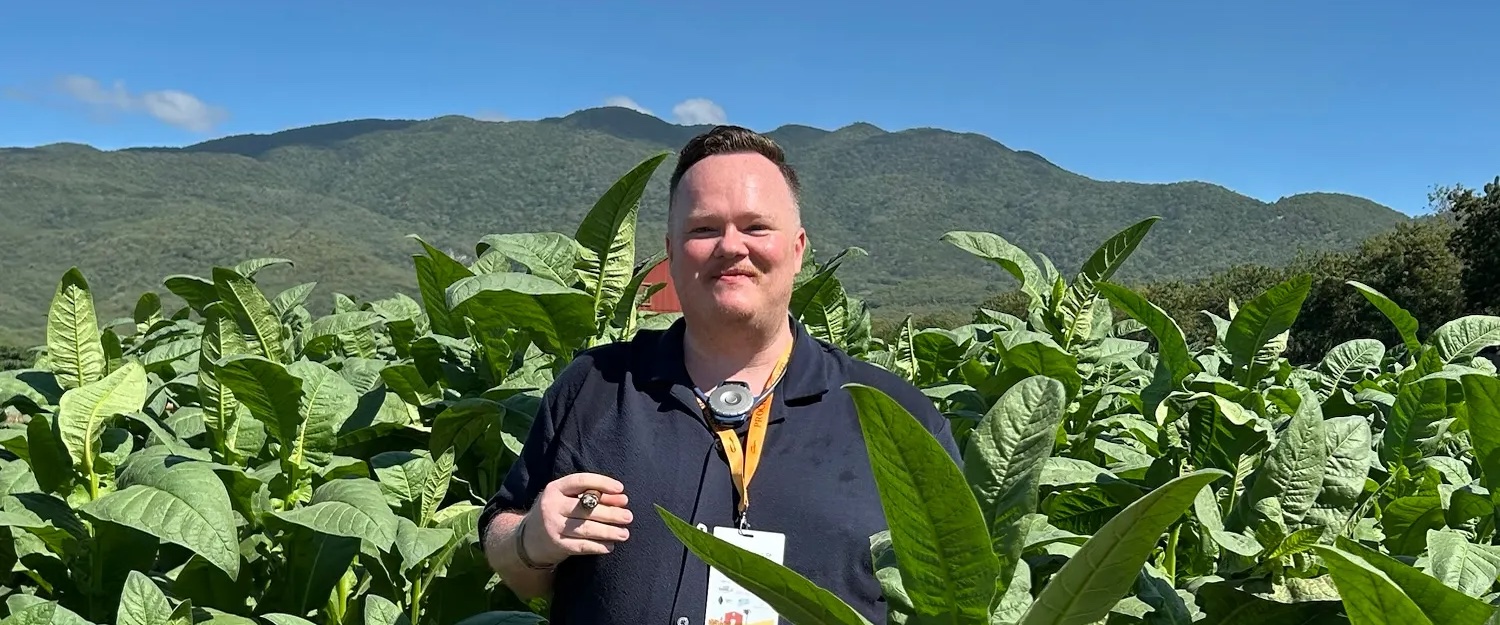
The ProCigar Festival is the Dominican Republic’s annual celebration of premium cigars, held each February in Santiago de los Caballeros and the surrounding tobacco-growing regions. Timed deliberately with harvest season, it is the time of year when the industry opens its doors — granting access to tobacco fields, curing barns, fermentation rooms, and factory floors.

I visited three factories during the festival. The first was Davidoff – and here’s how it went down👇.

After years immersed in the hobby, standing in the fields and factory of a brand that has played such a defining role in my cigar journey felt quietly surreal.
My mind drifted back to my first visit to Davidoff of London, where I purchased and smoked my first “proper” cigar after previously dabbling with the occasional King Edward. Years later, I joined the late Nic Wing on one of his cigar walks and sampled a cigar with Edward Sahakian in the shop.

During lockdown, I lit my first Davidoff Winston Churchill Late Hour as part of a personal cigar challenge — and it completely blew me away. I fell in love with it right there; it’s still one of my all-time favourites.

A few years later I returned to the Davidoff of London shop and got to meet both Edward AND Eddie!
Standing in the Dominican Republic, those moments no longer felt isolated milestones. They felt like stepping stones — leading back to the very place where it all begins. Maybe I should have titled this post – from shop to seed 😊.
The Origins: People Behind the Process
The experience began the evening before the tour at the ProCigar warm-up reception, where I met Henke Kelner — the first president of ProCigar and one of the architects of the modern Dominican premium cigar industry.

Kelner sold his farm and production operations in the 1990’s to Oettinger Davidoff AG during Davidoff’s expansion into the Dominican Republic, working closely with Zino Davidoff to shape what would become Davidoff today.
In a fitting full-circle moment, he introduced me to his son, now living and studying in London — proof of how small and interconnected the cigar world can feel.

Kelner also mentored Hamlet Espinal, now Vice President and Head of Global Production for Davidoff Cigars. Hamlet was our guide through both field and factory — alongside chief agronomist Carlos Alcantara.
The Tobacco Fields
At dawn, we boarded a bus from our hotels, which transported us to the factory and field tours each day.


As we neared Davidoff’s Schneider Farm in Villa González — named after the founder of Oettinger Davidoff, Ernst Schneider — I pressed my face to the bus window and gasped, utterly stunned by the vast, breathtaking tobacco fields before us — what a view!


We began the tour in a rustic hut overlooking the fields, cigars and coffee waiting for us.


Lighting a cigar in the very place the tobacco is grown is something special.

Hamlet kicked things off!

From Seed to Soil (to Shop)
Davidoff’s vertically integrated model controls every step of the process, from seed selection to the final product. It begins with the careful selection of seeds. Seeds harvested from the previous crop are stored in a refrigerated facility until the next planting cycle (unfortunately, photos are not allowed inside the refrigerator).

Only the healthiest seeds are chosen, with some being refined across multiple generations before they can be commercially used. Every batch is cataloged, and each crop is traceable.
Greenhouse operations commence as early as September. Seeds are planted in soil that has been prepared for optimal drainage and sometimes mixed with ash to ensure even distribution.


Rice husks are used to protect the fragile seedlings, and tray sizing and spacing are meticulously calculated based on long-term production forecasts.


Nothing is left to chance — planning is done several years in advance.
Field – Growth & Harvest
The farm spans approximately 10 hectares (about 25 acres) and features black, sandy soil, which is ideal for growing wrapper tobacco. A precise drip irrigation system effectively delivers water and nutrients directly to the roots of the plants.

Davidoff spaces out its planting and harvesting throughout the season, allowing different fields to reach maturity at various times. This approach gives them precise control over both crop quality and workflow.
During my visit, I jumped at the chance to plant seedlings — an experience you don’t get to have every day – especially as somewhere as esteemed as Davidoff.


The harvest season runs from October through March, and each leaf is cultivated with intention.
The filler provides strength and complexity, the binder offers structure, and the wrapper contributes aroma, appearance, and character.

Achieving balance is essential!
Curing & Fermentation
After harvest, leaves are air-cured in farm barns, slowly drying under controlled ventilation and beginning chemical transformation.


Fermentation follows in both farm facilities and factory warehouses, which is arguably the most critical stage.
Inside the Factory
The Davidoff factory is in Jicomé, around 16 miles from the farm.

Leaves are sorted by their priming — each level of the plant exhibits different characteristics — and are then stacked into pilones, which are large fermentation piles.

Temperature and humidity are continuously monitored throughout the process.

During fermentation:
- Ammonia and excess nicotine levels are reduced.
- Chemical compounds convert into sugars.
- Flavours develop to become more rounded and balanced.
- Elasticity improves.

If temperatures rise too quickly, the piles are turned to ensure proper fermentation. The process is guided rather than forced.
Before any blend advances, test cigars are rolled and smoked internally. Factors such as combustion, ash, and construction are carefully assessed.

Only when all aspects meet the desired standards does the tobacco move forward in the process.

Rolling, quality control, and finishing are conducted with utmost precision and consistency.
Ageing
Some leaves are aged for one year; others for two or more, particularly for limited releases.

The Davidoff factory employs over 2,000 people, but I’m not sure the employees were too happy with us during an unexpected incident.

One enthusiastic smoker accidentally triggered the smoke alarms while we were touring the factory floor, leading to a quick evacuation of the entire facility.
The workers calmly filed outside, which definitely wasn’t part of the itinerary. 🙈😬😄
Once operations resumed, we continued our tour through the production areas and observed how consistency is maintained at every stage of the process.

Davidoff Lunch
After the farm visit and factory tour, we enjoyed a Davidoff lunch — amazing Dominican food, abundant rum, and excellent cigars shared among enthusiasts and industry figures.


My final thoughts
Watching the entire cigar-making process really changes your perspective on cigars. You start to appreciate the meticulous attention to detail and the expert craftsmanship involved in EVERY aspect of cigar production, before it gets into our hands as a cigar smoker.
After observing each stage in order, it becomes clear why cigars are priced as they are. That said, I still wish the Davidoff Maduro were a bit cheaper so I could afford to try it next time I visit Davidoff of London! 😄
Here’s a little video from the tour:
Interested in visiting?
This visit was part of the ProCigar Festival. If you are considering attending, details for next year’s 2027 festival will be available on the official ProCigar website later this year!
Leave a Reply