The ProCigar Festival is the Dominican Republic’s annual premium cigar event, held each February in Santiago de los Caballeros, opening the industry’s fields and factories during harvest season.

I visited three factories during the festival. The third and final one was La Aurora – its said to be the oldest cigar factory in the Dominican Republic — and here’s how it went down👇.

Firstly, a great cigar doesn’t just happen. It’s the result of a long, disciplined process that starts with tobacco growing and continues through curing, fermentation, ageing, blending and craftsmanship. Every single step (and there are many) takes knowledge, patience and respect for the land and the tobacco. That “from seed to smoke” approach was exactly what we experienced on this tour.
The fields
When our tour bus pulled up to La Aurora, we stepped off and were warmly greeted by the family behind the brand. They told us that this year marks 123 years since the company was founded in 1903 by Eduardo León Jimenes!

As Guillermo León, a proud third‑generation member of the family, shared that the fourth generation — Michelle and Daniela — are already stepping up to carry the legacy forward, infusing new energy and passion into the craft that has defined their family for decades.

It was an honour to receive such a warm welcome from the family. Their mission was straightforward: to immerse us in the full journey of cigar making, beginning with the plants themselves — from selecting the seeds and nurturing them in the fields to curing and fermenting the leaves. I had also heard whispers that we might get the chance to roll our own cigar during the tour.
Before we knew it, we were guided into a climate‑controlled greenhouse.

Before any seeds go into the soil, they’re carefully grown and selected in controlled spaces to ensure consistency.

Seeds are started in trays or beds, and healthy seedlings are moved into their own containers to grow evenly.

What stood out was how precise everything was: trimming leaves to strengthen plants, strict cleanliness and constant care to produce healthy plants ready for the field.
Preparing the soil is a big job too. Samples are taken, nutrient levels checked, and adjustments are made before planting begins.

Once transplanted to the field, the plants are closely monitored, regularly fed, and mounded with soil around the base to help roots grow strong.

After about 55–60 days for some varieties, leaves are picked two at a time starting from the bottom. Skilled farmers judge the right moment to harvest by how the leaves look and feel.

One interesting thing we saw: wrapper tobacco (the fine outer leaf) is often grown under white mesh that cuts about 30 % of the sun’s light so the leaves stay thinner and finer — ideal for wrappers — while filler and binder tobacco grows in full sun to produce thicker leaves.

Harvested leaves go to curing barns, where they slowly change colour before they’re ready for fermentation.

Towards the end of the first part of our trip to the fields inside the curing barn we were given a short tutorial — the very start of our cigar-making experience.

We learned about the different types of tobacco leaves and how each contributes to a cigar’s flavor, strength, and burn. Something I still wish I could forever remember off the top of my head.

We also learnt about taste – I remember doing this a couple of years ago during a cigar masterclass.

And we sampled different filler tobaccos

This was where we sampled various filler leaves, and it was here that we chose the filler tobacco for my own custom blend.
I was sitting next to a guy from Cigar Journal, and on the other side were the makers of Boveda—who, I believe, were sponsors of the festival. The pressure was definitely on! It all felt so surreal.

To be honest, this part was a bit confusing — I wasn’t really sure what my percentages were actually measuring, and that determined how many tobacco leaves I’d later collect. I didn’t fully grasp what I’d selected, but someone said my cigar would be a mild one. It’s probably gonna be a bit sh*t lol—but hey, it’s the taking part that counts, right? 😄😂
The factory
Next stop… the factory!

We were shown around briefly before heading straight to the room with all the tobacco.

There, we collected the amount of leaves we had chosen during our filler selection.

Once we had that in hand, we were taken to the rolling rooms.

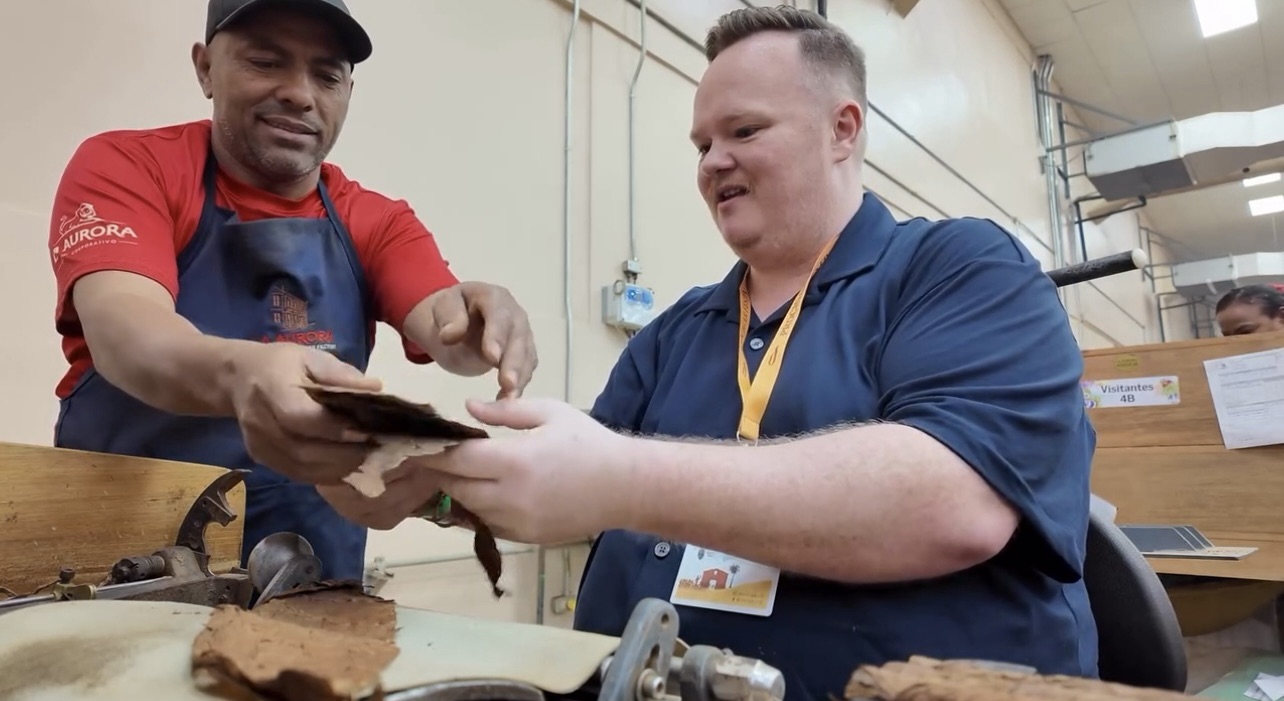
To my surprise, this is where we didn’t just watch the rollers at work—we actually got to roll the cigars ourselves! At first, I didn’t realise they were teaching us step by step, so the first two times were demonstrations.

When it was my turn to jump in, I just didn’t want to f#ck it up! 😂 I followed all the rules, but it really made me appreciate how skilled these men and women are 🫡.
Watching them roll is incredible, and actually doing it myself was a dream come true. Putting the filler and binder together then covering it with the wrapper and the cigar cap. I never imagined I’d get the chance to do anything like that.

After rolling, we pressed the cigars for a while.

Whilst we waited, we took part in a focus group and sampled a new cigar from La Aurora that is gonna be making an appearance at this year’s PCA.


They wouldn’t give the name away! I did ask 😄.

Later, we went back to the rolling room to pick up our freshly pressed cigars and then stopped by another room to attach the cigar bands.

Once the cigars were banded, each was wrapped in cellophane, and we were guided to the packaging area, where they were carefully boxed.
The box even had London Cigar Smoker added to it too!

Such a nice touch. I loved every minute — it was amazing that they let us take part, especially while they were busy doing their own work — they prob don’t need us tourists clogging up the place 😅.
When we made our way out, we walked past the cigar shop and lounge.


I’m not sure if it’s always open to the public, but they had some great cigars there. The most random one I ended up buying was a massive La Aurora Stravaganza (80 ring gauge, 20 inch in length 🤯) for $33. It was absolutely huge. This was defo an impulse buy – when am I ever gonna get the chance to smoke this one 😂! It’ll take me at least 8 hours to smoke.

I also picked up some merchandise — I like buying things like that when I visit places like this. I got a La Aurora baseball cap, which I’ll probably never actually wear, but I had to buy it while I was there. Of course, a lot of the Americans on the tour bought quite a few cigars as well.
For me, though, during the trip we had dinners every night, and at the end of each one — four in total — we were given a box of 10 cigars. By the time it was time to leave, it was actually a bit sad, because I had to leave some cigars behind, to stay under my 50-cigar limit. That’s definitely not a situation I ever expected to find myself in. 😅
Before we left, we had an incredible lunch.

It turned out it was one of the daughters’ birthdays, so everyone ended up singing Happy Birthday before we headed back to the bus.
It was a brilliant day — honestly one of the highlights of the trip.
Seeing the entire process “from seed to cigar”, and even getting to take part in it, was an experience I’ll never forget – been saying that a lot lately, but it’s true!!!
Interested in visiting?
This visit was part of the ProCigar Festival. If you are considering attending, details for next year’s 2027 festival will be available on the official ProCigar website later this year!
Leave a Reply