
Over the past few years, I’ve set myself a personal mission: to visit every single cigar shop, sampling lounge, and cigar-dedicated terrace in London. So far, I’ve explored and reviewed around 44 establishments across the capital – most people are surprised at how many there are in one city.
Along the way, one pattern has become impossible to ignore. Whenever I ask who built the humidor — whether it’s a discreet cabinet in a specialist cigar shop or a vast walk-in installation in a luxury hotel cigar sampling lounge — the same name comes up again and again: Massimo de Munari, of the Italian furniture house DeART.

DeART specialises in bespoke cigar humidors, ranging from elegant private cabinets to large-scale installations for hospitality venues. In London alone, their work can be found in approximately 35 cigar establishments 😳😄, instantly recognisable for their precision, material quality, and quiet, understated luxury.
One of DeART’s most celebrated creations — and the one Massimo is most proud of to date — is the Trinidad 55th Anniversary Humidor, produced exclusively for Habanos S.A. in a strictly limited edition. These festival humidors routinely sell for extraordinary sums of money at the annual Festival del Habano in Havana, Cuba.

Massimo has also designed highly exclusive humidors for the Monte Carlo Cigar Club and is currently working on not one but two humidors for the new flagship La Casa del Habano, Pall Mall, set to open this March 2026 with Dominique London.
Within the cigar world, Massimo occupies a position comparable to luxury fashion houses like Louis Vuitton or Versace — not through branding, but through reputation, consistency, and trust.
How this visit came about
Over the years, and I can’t believe I’m writing this, I’d crossed paths with Massimo several times. The first was a FaceTime arranged by Antonino during my visit to the cigar terrace at The Beaumont, after I’d spent ages admiring their humidor featuring a Cuban tobacco-leaf motif.


We later met in person at The Emory during the launch of EGM’s Empyrean cigar line, where — very casually — Massimo personally invited me to visit his DeART factory for a private tour. Mind blown 🤯. It was an invitation I never expected to receive 🙏.
Our paths crossed once more at the recent launch of the Punch Princesas Edición Limitada 2025 cigar in Cyprus.

It was here where we finally aligned dates to coincide my visit with the build schedule for this year’s Habanos Festival humidors. Details on those will follow once they’re public — trust me, they’re incredible! 🤩
Arrival in Italy
Last weekend, I flew from London Stansted to Milan Bergamo (thank you, Ryanair), then continued by train to Treviglio. Massimo was waiting for me at the station — a genuinely surreal moment.
During the drive, I started firing questions his way. He explained the origin of the DeART name — “De” from de Munari, his surname and “Art” representing the craft itself. We also talked about the company’s former name, Cigar Time, which still appears online occasionally but is no longer used as it didn’t really stick and people preferred DeART.
As we passed through the area, Massimo pointed out DeART’s original workshop: a historic, multi-storey building that played a crucial role in the company’s early years, but was ultimately unsuited to modern production. That led to the move to DeART’s current, purpose-built headquarters in Calvenzano.
The DeART factory
A couple of years ago, AJay from No.6 Cavendish shared a rare Instagram story from inside the DeART factory. I remembered it instantly as we pulled up — and realised just how few people ever get to see this place.

After a few quick hellos (and ciaos) with the reception team, we headed straight into the boardroom.
Inside the Boardroom

Standing there felt like stepping into a cinematic control room — part James Bond, part museum.

The space is lined with showcase humidors and furniture samples representing decades of work. It’s less a meeting room and more a gallery of the world’s finest humidors.

It was intriguing to see some of the humidors that didn’t quite make it to the cigar festivals — like this one for La Gloria Cubana.

Massimo began by sharing the company’s origins.
DeART was founded in 1962 by his father, Giovanni de Munari, whose background lay in monumental, classical furniture for elite clients.

“My father made extremely traditional pieces — very heavy, very classical. We built enormous conference and dining tables, including one 25 metres long, and another seven metres in diameter for the Sultan of Oman. Some projects took years to complete.”
The move into tobacco-related work came later, beginning with pipe humidors and stands. As Massimo gradually took on a leading role (alongside his brother, who is no longer involved in day-to-day operations), he recognised the potential of the cigar world — despite not being a cigar smoker at the time.
Early relationships within the London cigar scene eventually led to DeART’s first major humidor commission: The Lanesborough, around 2009. That project marked the true beginning of what would become one of the most significant humidor portfolios in the world.
DeART humidors across London
Before seeing how these cabinets and humidors are built, it’s worth understanding just how embedded DeART already is in London’s cigar scene landscape.


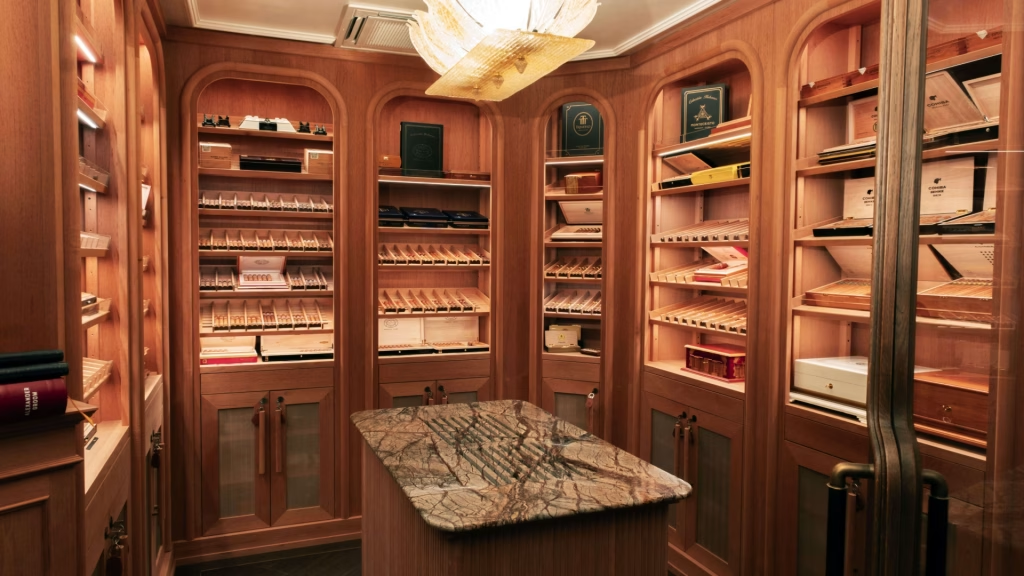


Below is a list of venues where I’ve identified DeART humidors so far, with approximate installation dates (do let me know if you spot any errors folks):
| Year | Establishment |
|---|---|
| 2009 | The Lanesborough Hotel |
| 2011 | Corinthia Hotel London |
| 2012 | Bulgari Hotel London (Edward Sahakian) |
| The May Fair Hotel (Cigar Room) | |
| The Wellesley Knightsbridge | |
| 5 Hertford Street | |
| — | The Arts Club (main club) |
| — | Harry’s Bar |
| — | Jumeirah Carlton Tower |
| — | Mark’s Club |
| — | The Connaught Hotel |
| — | The Churchill Bar & Terrace |
| — | Cavalry & Guards Club |
| — | Four Seasons Hotel at Ten Trinity Square |
| — | No. Ten Manchester Street Hotel |
| 2013 | Hotel Xenia |
| 2014 | The Beaumont Hotel |
| Havana Cigar Exchange | |
| 2017 | 148 Kensington Cigar Shop |
| 2018 | Annabel’s (reopened) |
| Oswald’s Club | |
| La Casa del Habano Harrods (James J. Fox) | |
| 2019 | The Arts Club, Oscuro |
| The Langley | |
| Tom Tom Cigars London | |
| No.6 Cavendish | |
| 2021 | Jeru |
| 2023 | The Peninsula London |
| 2024 | Langan’s Brasserie |
| James J. Fox | |
| Fumar | |
| The Emory | |
| 2026 | La Casa del Habano Pall Mall |
| 2026/27 | The Ritz London |
Today, DeART employs around 26 people, working across two core areas: bespoke cigar humidors and cabinets, and large-scale custom interiors — including yacht projects.
One of the most significant partnerships is with Azimut Benetti, one of the world’s leading yacht builders. During my visit, Massimo spoke about his latest commission, the Azimut Seadeck 9, which — by coincidence — was being officially launched that very day.

The philosophy behind DeART humidors
When Massimo talks about humidors, his passion and expertise are immediately apparent. These aren’t just cabinets — they’re carefully engineered containers designed to keep cigars at the ideal humidity and temperature, preserving their flavor, freshness, and preventing them from drying out or developing mold.

Originally, DeART focused solely on humidity control. As client expectations evolved — particularly in London — temperature control became equally important. Rather than rely on off-the-shelf solutions, Massimo developed a fully proprietary system.
Every DeART humidor now uses an integrated unit discreetly positioned at the base of the cabinet. Air circulates through concealed channels to ensure even distribution without compromising the design. Humidity and temperature can be monitored directly on the cabinet or remotely via smartphone when connected to Wi-Fi.
The system is fully automatic, alerts owners when water needs refilling (typically every two to three months), and uses a UV purification lamp inside the water tank to prevent bacteria and odours.
Massimo was keen to address a common misconception:
“People panic when they see humidity move. But humidity and temperature naturally fluctuate — what matters is the 24-hour average, not minute-by-minute changes.”
At the heart of every cabinet is Spanish cedar, personally selected and treated by DeART. It remains stable at 70% humidity and acts as a natural buffer against environmental change.
Unlike competitors who control only humidity or rely on fixed refrigeration units, DeART designs each humidor from the ground up — fully customisable in size, layout, temperature, and humidity.
Massimo’s personal cigar collection
Massimo wasn’t a cigar smoker when he entered the industry, neither was his father. But his appreciation developed slowly, shaped by the people, the culture, and the rituals surrounding cigars.

Some of the cabinets in the boardroom aren’t displays — they house his personal cigar collection. On warm summer evenings, once the workshop has closed, this is where he comes to unwind. His wife doesn’t allow smoking at home (a few of you will be able to relate to this 😀), so the factory has become his refuge.
The showroom
Next, Massimo led me into the showroom — a vast walk-in humidor displaying examples of nearly everything he and his team produces.

Separate systems manage humidity and temperature overhead.
The showroom houses earlier collaborations, including a Hunters & Frankau 225th Anniversary Humidor from 2015,


and a James J Fox 230th Anniversary Humidor from 2017, echoing the shop’s exterior – check out Winston Churchill walking on by 🫡.


Nearby stood another milestone: the humidor created for the Trinidad 50th Anniversary for Habanos in 2019.


It later sold at auction for just over 260k. Inspired by the façade of the Habana Libre Hotel, it marked Massimo’s first official collaboration with Habanos.

The 55th Trinidad anniversary humidor made in 2024 sold for approx 3.3 million quid.

Not all brands are equally accessible. Cohiba projects, he explained, are politically sensitive and usually reserved for Cuban makers — though he showed me several pitches, sadly none of these saw the light of day – all of them stunning!
He showed me an early prototype of the 2025 Por Larrañaga humidor, created with Hunters & Frankau. “It wasn’t perfect at first,” he said, “but it was the start.” Only 50 units were made, and the first never left the workshop.


The Technical Office
Before anything reaches the factory floor, every DeART project passes through the technical office. This is where all drawings, specifications, and CAD work are produced.

The team is split into two specialist groups: one focused entirely on cigar humidors and cabinets, the other on yacht interiors and large-scale bespoke furniture.

At the time of my visit, projects were underway in London, Hong Kong, and Italy, spanning cigar lounges, wine rooms, private residences, and superyachts.

Every humidor begins life here — digitally. Dimensions, airflow paths, internal cedar linings, shelving layouts, cooling units, and service access are all planned in detail before a single piece of wood is cut. Interestingly, they’re also beginning to use AI tools to explore alternative mock-ups during the early stages of iteration.

I was lucky enough to get a few sneaky previews of projects destined for London later this year — some serious impressive stuff is coming our way in 2026! 😍

Once a design is finalised and approved by the client it moves into production.
Inside the Factory
The factory is laid out in a logical, linear sequence — starting with raw materials and ending with fully crated installations ready to ship.

Raw materials are delivered and prepared for machining. DeART was among the first companies in the region to adopt American-controlled CNC machines, installing their first units in the early 1990s. Newer, more advanced models were added around two years ago.

All components are cut digitally.

Each individual piece is tagged, ensuring that every worker knows exactly where it belongs within the final cabinet — essential when producing complex humidors containing hundreds of unique parts.

From there, components move through spraying, drying, and finishing stages before final assembly. CNC handles precision, but finishing, fitting, and assembly remain highly hands-on, reliant on experience and touch.

Once complete, each humidor is packed into custom-built crates, clearly labelled so receiving teams — whether at hotels, shipyards, private residences, or festival venues — know exactly how to reassemble and install the piece.

At the far end of the factory, trucks wait to collect finished crates. During my visit, components destined for UK cigar lounges were already in progress.
The Festival Humidors
One of the most surreal moments came when we stepped into the space housing this year’s Habanos Festival humidors for the XXVI Festival del Habano.

These are the very pieces auctioned during the gala dinner in Havana — humidors that often fetch extraordinary sums. Seeing them lined up, finished and ready to be shipped to Cuba, was a sight I’ll never forget!
What surprised me most was the creative freedom Habanos grants humidor makers. For these projects, they only provide the quantity of cigars required and the brand, leaving the historical research, concept development, and design proposals entirely up to DeART. This process, which can span months, involves careful review and approval. For this particular project, final approval arrived in October, leaving the team with less than two months to complete everything — including during the Christmas period when the factory is usually closed. Despite the tight timeline, the humidors were completed on schedule and are now ready to ship, waiting to leave DeART in trucks to Madrid then to Cuba by air.
Once they’re officially revealed, I’ll share a dedicated post on them — they definitely deserve it 👏.
And just like that, the tour came to an end. But the adventure didn’t stop there. In the late afternoon, Massimo took me to Milan to check out a few of the humidors DeART had crafted and installed. The very next day, we also drove to Switzerland to see more of his creations for La Casa del Habano – whose owners were absolutely fantastic. I’ll save the details of these adventures for future blog posts.
Final thoughts
Walking through the DeART factory, it’s impossible to see a humidor as just an accessory or an ordinary piece of furniture. Each one is the product of meticulous engineering, expert craftsmanship, and decades of accumulated knowledge — designed to operate quietly and flawlessly for years.
The attention to detail in these humidors instantly reminded me of the care that goes into making cigars, bringing back memories from my trip to Cuba last year. It was fascinating to watch and hear how these humidors come to life — from the initial brief and conception of the idea to the final product, carefully packed in crates and ready to be shipped.
It also made me realise that these collector humidors, with their cigars inside, aren’t really meant to be smoked — once they are, the value of the humidor itself decreases. Hearing it from the man himself made it even more real.
What inspires each humidor is fascinating, and I loved seeing the original artwork behind the scenes — including pieces that didn’t quite make the final cut. Listening to Massimo talk about the process was captivating. He no longer remains a man of mystery to me — he is brilliant, kind, and was endlessly patient, letting me hang out over a couple of incredible days and answering every question I threw his way 🙏.
I hope this post does justice to the level of thought, detail, and obsession that goes into every DeART humidor. Next time you open one, or walk into one, take a moment to ask: Who made it? How and why was it created the way it was?
Honestly, I feel so lucky to have had this experience. And to think, it all started with this crazy little blog where I reviewed cigar shops and lounges across London to now being in Italy at a humidor factory with DeArt blows my mind. What a journey it’s been — and I’m all in for the ride! 🚀
Here’s a little video of that trip:
If you want more details about Massimo and DeART visit their website at: deart.it
Leave a Reply